Every story I write starts with a brainstorm. Once I know what my assignment is for a cycle, I’ll sit down and think through it. The first thing I always do is make a list of the people involved – after I’ve made my list, I send emails or direct messages to the people I want to interview so I can get right to work on my story. The next thing I do is come up with a list of 10 to 15 questions for each source I’m hoping to interview, each one tailored to the source. Even though I don’t always use each question and will add others on the spot when I come up with them, I like to make sure I’m prepared to fully cover the subject. While I do research for every story, some require more than others. Whenever I cover sports, for example, I make sure to do some close reading on the rules of the game and how our season’s been going. I’m not the most athletic person, so I know that I’ll need to do some extra work to be prepared to cover sports.
One of the stories I worked on that presented the biggest challenge in news gathering was a piece I did on the school computers called “GlobalProtect doing more harm than good“. The county school system had installed a new security program called GlobalProtect on all the student laptops during computer re-imaging at the end of the previous school year. The software was designed to filter out sites that were not appropriate for students, but ultimately prevented a lot of students from being able to connect to Wi-Fi for significant periods of time, impeding learning. The software was incredibly unpopular amongst students, with one going so far as to start an online petition to have the software removed.
Even though it was an opinion story, there were so many moving parts that I needed to capture. After doing some research, I learned that federal law required school technology to have filtering capabilities, but I knew there had to be a reason that the county decided to put this program on all the computers. I reached out to the superintendent’s office and found out that GlobalProtect was picked because it allowed the filtering level to be adjusted for different grades – high school students and elementary schoolers wouldn’t receive the same filtering.
The computer problems were a hot topic amongst the student body, though, and I knew that this opinion piece needed to be strong. I spoke to students about the complaints they had and found that they aligned with my points, so I was able to use student quotes to reinforce my points.
News gathering doesn’t always consist of careful planning, though. For the past few years, members of my community had been discussing the name of my school. Formerly called Washington-Lee High School, many people wanted to change the name to not include “Lee” because of the connection to the Confederacy. The issue was incredibly divisive, and debates over the potential change lasted for years and included lawsuits about the way the School Board conducted the process.
The night of the School Board meeting when the final decision was being made, I watched the meeting livestream on my TV at home. I was logged into our Publication Lab’s Twitter account, used by the newspaper as well as our yearbook, broadcast and literary magazine. It was my job to cover the results when they happened. I tweeted updates and was the first person to cover the name change decision – I got the news out before any local news organizations and any Arlington Public Schools social media or news posts.
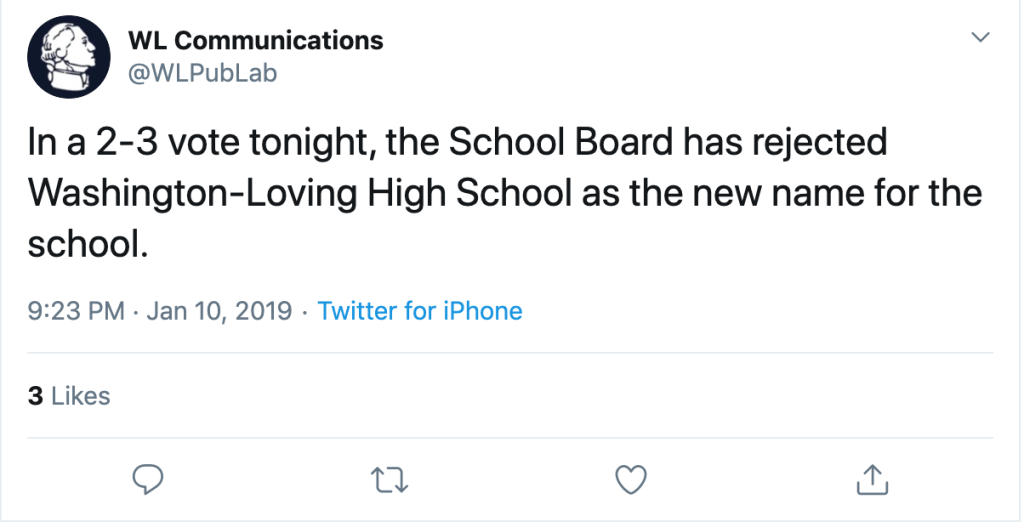

The feeling of breaking such important news for my community was incredible. Being on the front lines of a major story like the name change decision reinforced that journalism was right for me. I had been able to follow the story through, from covering the initial stages of the process to breaking the final decision.
 Abby Presson